Round-Robin or Knockout? Two Ways to Shape a Tournament
Round-robin or knockout formats shape every contest differently. See how repeat matches, elimination, and scheduling change the route competitors take.
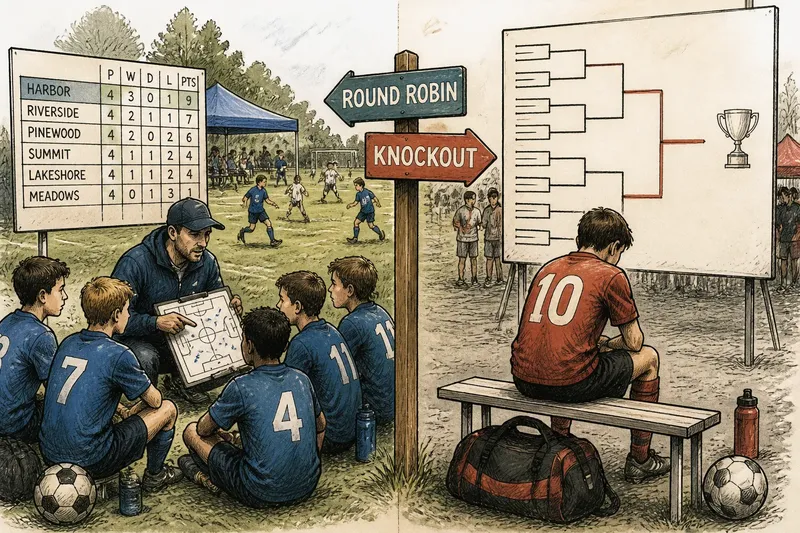
A team loses its opening match, packs its kit, then discovers it still has three fixtures to play. That is an ordinary turn in a round-robin tournament; in a knockout bracket, the same defeat may end the team’s run before the afternoon is over. Round-robin or knockout is not just a scheduling choice. It decides how much room competitors have to recover, what each match means, and how the event’s story unfolds.
These formats also give spectators different things to follow. One builds its verdict across a sequence of contests; the other puts a sharp edge on each pairing. Neither is automatically fairer or more exciting. The useful question is what kind of competition the organizers want the format to create.
Two different promises
In a round robin, each entrant plays every other entrant in the group, or every other entrant in the event if it is a single pool. Results accumulate in a standings table. Depending on the sport’s rules, wins, draws, points, sets, or other results determine the order, with published tiebreakers used when entrants finish level.
A knockout tournament pairs competitors in successive rounds. The winner advances and the loser is eliminated; a final decides the champion. Some events add a bronze-medal match, consolation bracket, or placement games, but those are extra routes around the central winner-advances structure.
The formats make different promises: a round robin offers repeated chances to establish a record, while a knockout offers a direct route from one contest to the next. That distinction affects the emotional weight of a loss. In one format, it becomes part of a larger account. In the other, it can be the whole account.
The recovery route
Repeat contests let a competitor answer an earlier setback. A team may start cautiously, adjust its tactics, and improve its position in later fixtures. That does not erase a loss; it gives the team a chance to show more than one performance. For a player returning from an off day, the remaining schedule can feel like an open door.
But a round robin does not make every match equally consequential. An entrant that has already built a commanding record may have less at stake in its last fixture, while a rival’s qualification may depend on it. A draw, a late score, or a tiebreaking detail can ripple through the table. Fans may need to understand the standings as well as the action to see what a result changes.
Knockout play strips away that long accounting. A strong favorite can be sent home by one poor stretch, a matchup that suits its opponent, or a single decisive mistake. That makes each contest legible: advance or exit. It also leaves little room to recover from a bad start, even if the team’s overall ability seems clear.
Say a fictional six-team youth league uses a round robin before selecting a final pair. Harbor finishes its first game with a loss, then wins its next matches by changing how it defends. The standings show whether that improvement is enough to reach the final; the opening defeat still counts, but it does not end Harbor’s participation. In a direct knockout bracket, the same opening loss would send Harbor out unless the event offered a separate consolation route.
Schedules shape play
A format is also a calendar. A round robin needs room for many pairings, and the order matters. If one team plays twice before another takes the field, rest and recovery become visible parts of the contest. Organizers may rotate start times, venues, or courts, but they still have to fit the fixtures into the event’s available window.
Knockout brackets can be shorter when there are many entrants, particularly if some receive byes into a later round. A bye is not a match win; it is a place in the next round without an opening fixture. That can help an event fit its schedule, but it means entrants may arrive at later rounds with different amounts of playing time. How a bracket assigns byes should be clear to competitors and spectators.
There is no format that removes the scheduling trade-off. More round-robin games mean more chances to play, but also more demands on fields, officials, travel, and recovery. A knockout path can save time, but a quick exit may leave a team with little competition for the trip. The right choice depends on the event’s purpose as well as its available space and time.
For a community event, a pool phase followed by a short knockout bracket can combine repeated play with a decisive finish. It is a hybrid, not a magic fix: organizers still need to explain how pool results determine seeding and what happens if teams tie.
Who meets whom
Round robins give every entrant in a pool a scheduled encounter with every other entrant there. That can make the standings feel more grounded in a shared set of opponents. Yet the table can still be shaped by the order of play, the strength of the pool, and the rules used to separate tied records.
Knockout pairings create a different kind of uncertainty. A bracket shows a possible path, but future opponents depend on who advances. A top seed may avoid another strong entrant until a later round, if the bracket is arranged that way. Conversely, a difficult early pairing can end a contender’s run before the final. Seeding can guide the route, but it cannot make every path identical.
For spectators, the bracket is a map with branches: each result redraws the next round. The standings table is more like a ledger, where a result can change several positions at once. If an event uses both, a simple explanation of the progression helps people follow why a team is still alive or already out.
What should organizers choose?
Start with the experience participants should leave with. If the aim is to give each entrant several contests and let performance accumulate, a round robin or group stage may fit. If the event is designed around a compact championship path and a clear champion, knockout play may fit better. For younger participants or recreational groups, organizers may value continued play enough to add consolation games after elimination.
Then check the practical limits: the number of entrants, playable venues, available officials, travel between sites, and time needed between contests. The format must be workable for the people running it, not just attractive on a chart. Where event rules or local requirements determine scoring, eligibility, or bracket procedures, follow those published rules.
- Clarify the purpose: Is the event meant to provide broad participation, rank a field, or crown a champion quickly?
- Count the fixtures: Can the venue and officials support the number of games the chosen format requires?
- Review recovery: Does the schedule leave reasonable rest between contests, especially for entrants playing multiple times?
- Publish the route: Show how teams advance, how byes work, and whether consolation games are available.
- Explain tiebreakers: State the order of criteria before play begins, so a close table does not become a surprise puzzle.
A clear format lets participants prepare and lets fans understand what is at stake. If the event combines pools and elimination, label the transition plainly: the pool determines placement or qualification, then the bracket determines who advances.
Which format fits?
Is a round robin fairer?
It gives entrants in the same pool a common set of opponents, which can make comparisons more complete than a single-elimination path. It still cannot remove differences in schedule, pool strength, or tiebreak rules, so fairness depends on how the event is designed and explained.
Does knockout play always mean one loss ends the event?
In a standard single-elimination bracket, yes: a defeated entrant leaves the championship route. Organizers can add consolation matches or a separate lower bracket, but those create additional competition rather than changing who advances in the main bracket.
Can a tournament use both formats?
Yes. Many designs use round-robin pools to determine qualifiers or seeds, followed by knockout rounds to decide the champion. The transition works best when participants can see how pool results translate into bracket positions.
What should a spectator watch for?
In a round robin, track the standings and any published tiebreakers as results come in. In a knockout, follow the bracket and notice how each pairing changes the next possible matchup.
The format is part of the game
A tournament’s rules shape more than its final table or trophy match. They determine whether a team can learn from a loss in public, whether one evening settles a season’s question, and how much of the event each entrant gets to play. Round-robin or knockout is therefore a choice about the competition’s character, not merely its calendar.
When comparing round-robin or knockout formats, look beyond the champion’s route: ask what a defeat means for the person who takes it, and whether the remaining schedule still gives that competitor a meaningful reason to return.